|
Remarks to the origin
of the Dakhla "Glass" (DG)
---- Product of an airburst/impact event
or of volcanic activities in the region ? ----
Norbert
Brügge, Germany
Dipl.-Geol.
Upload: 2013
Update: 05.10.2016
|
|
The origin
of the Dakhla Glass (DG) had puzzled scientists since MAXINE KLEINDIENST
discovered it in 1987 nearby the Dakhla Oasis (Egypt).
Some researchers had suggested the "Stone Age" glass may have been produced
by burning vegetation or lightning strikes.
But a chemical analysis showed that the glass was created in temperatures
so high that they could only have been the result of an impact event.
Gordon Osinski, a geologist at the Canadian Space Agency in Saint-Hubert
who conducted the analysis, found that the glass samples contain strands
of molten quartz, a signature of meteorite impacts.
"The Dakhleh Glass-forming impact
event occurred during the Middle Stone Age time of occupation, but the
timing of this event has not been well established. 40Ar/39Ar incremental
heating of three aliquots from a sample of Dakhleh Glass yield data that
can be ascribed to quenched glass which efficiently purged radiogenic
40Ar inherited from the target rocks. One of the aliquots yielded data
suggestive of an undegassed clast of target material, but these are easily
resolved. The age of the impact event is determined from a compositionally
filtered subset of the data that yield an isochron age of 145 ± 19 ka."
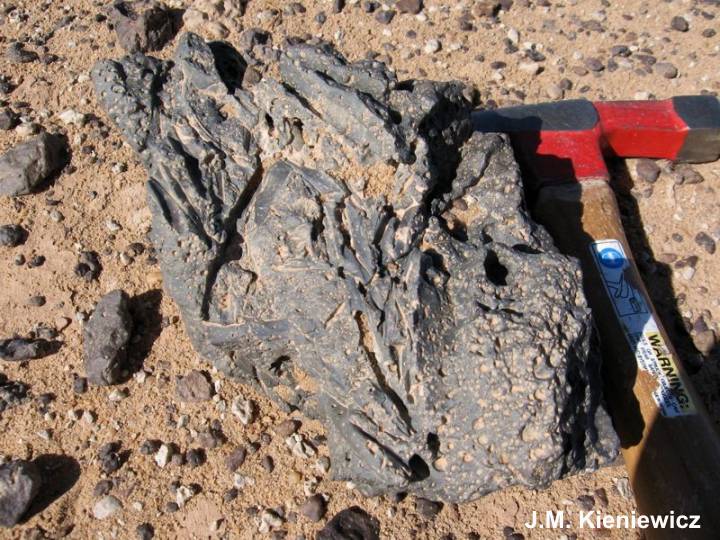
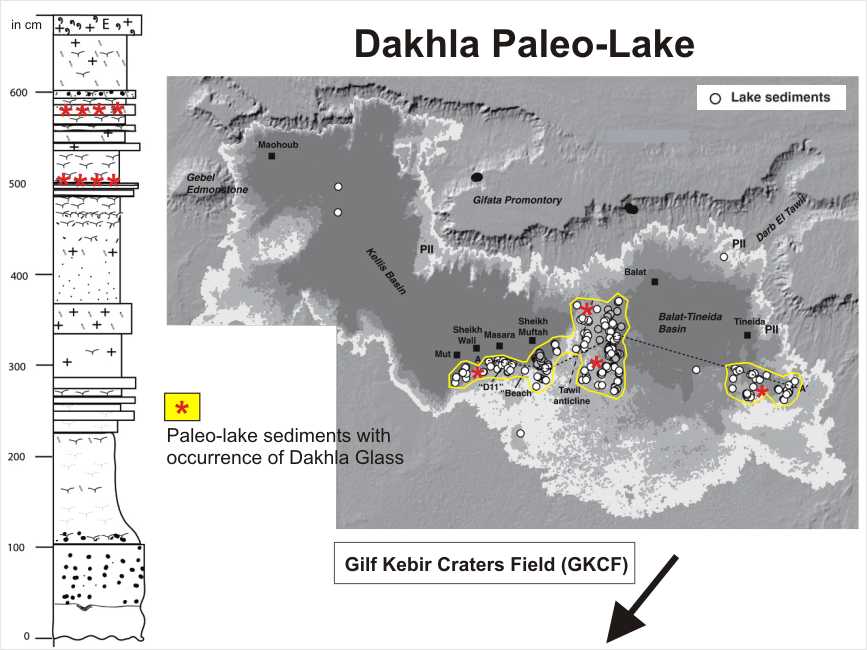
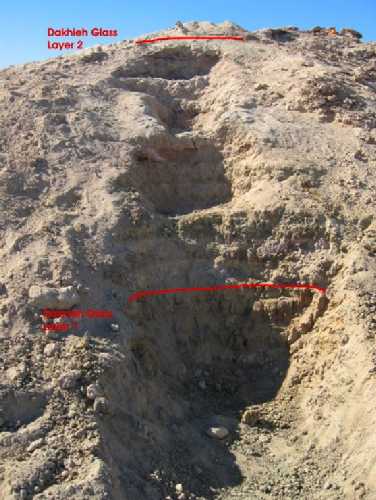
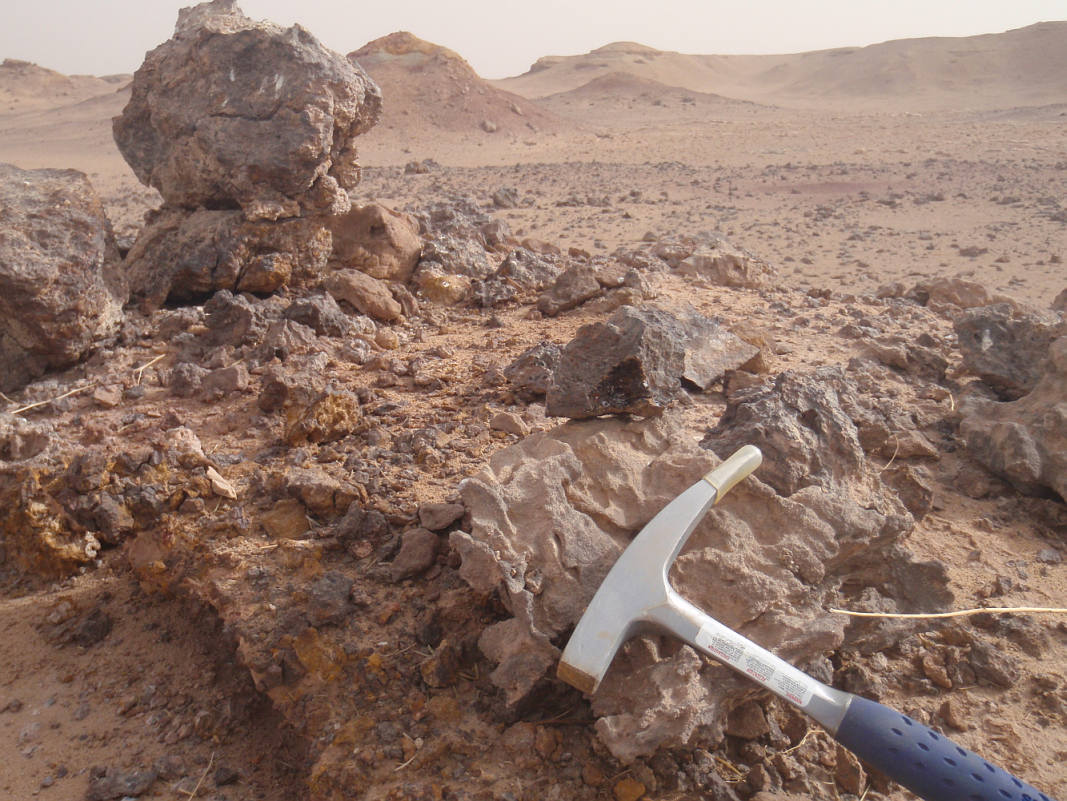
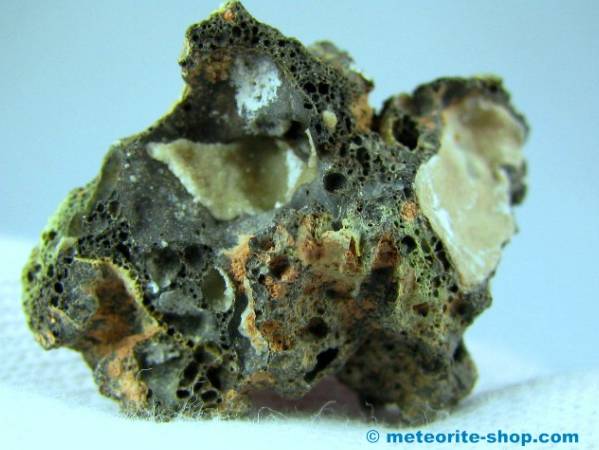
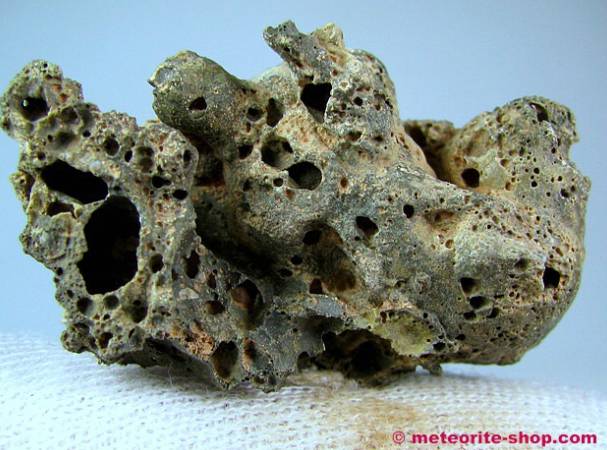
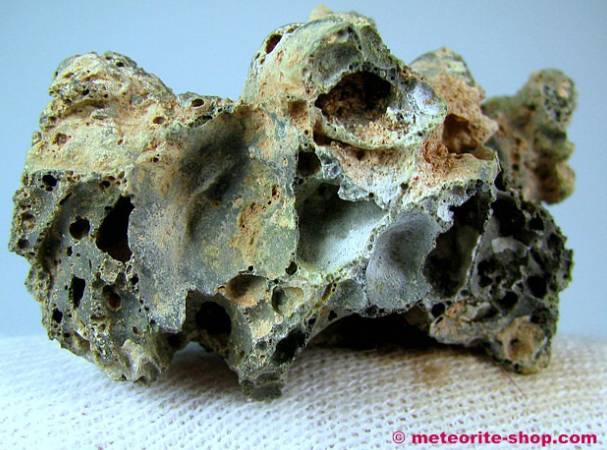
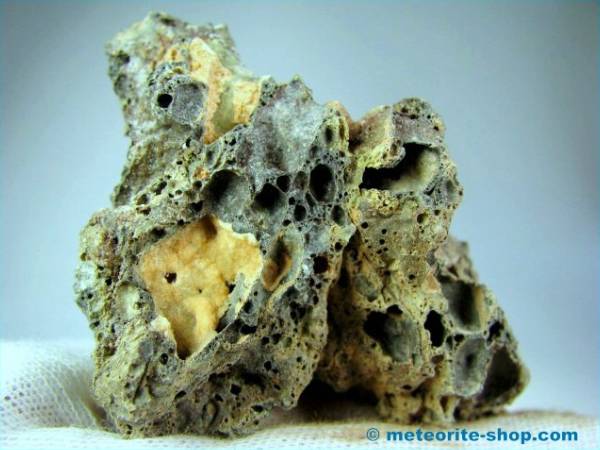
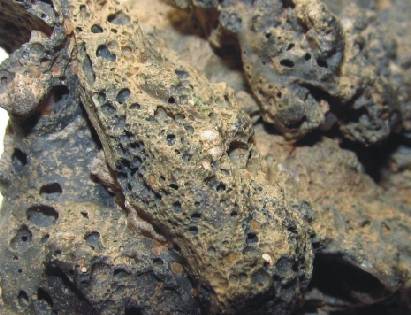
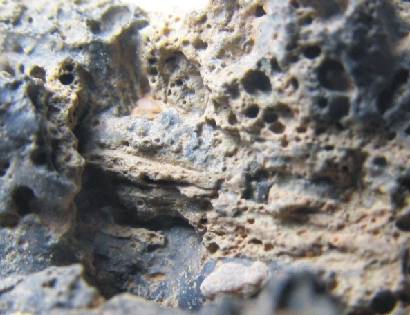
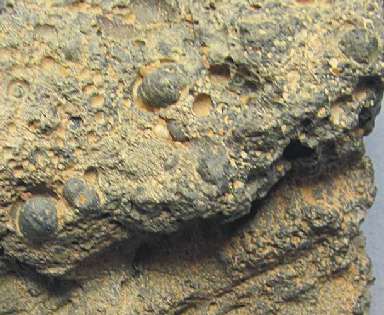
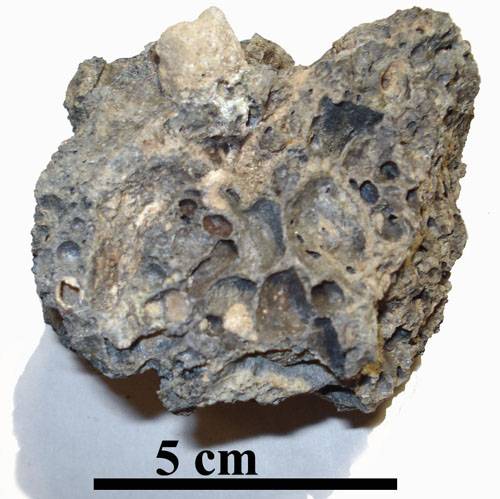
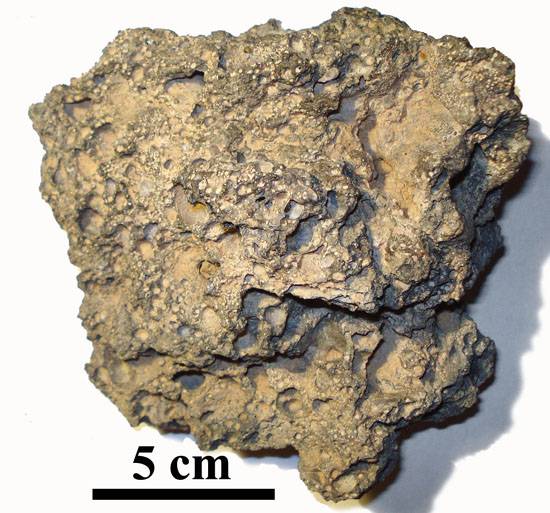
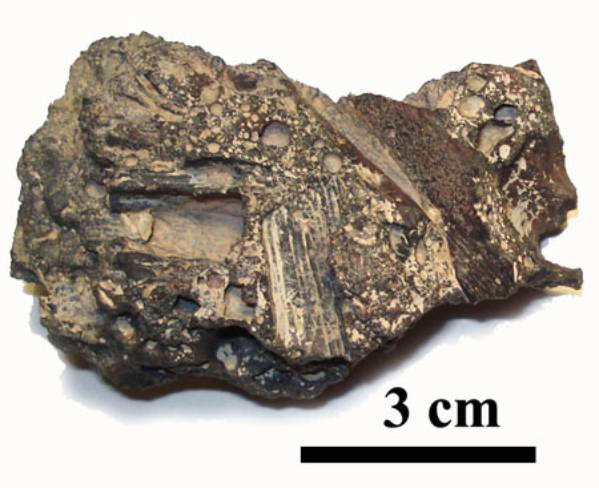
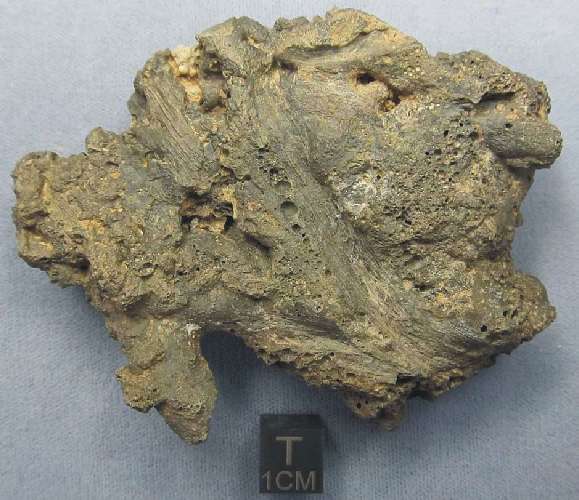
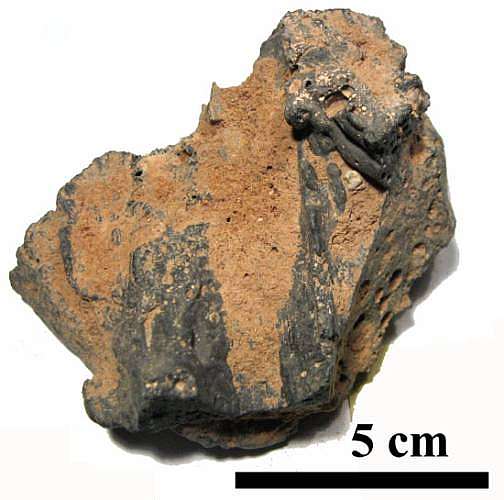
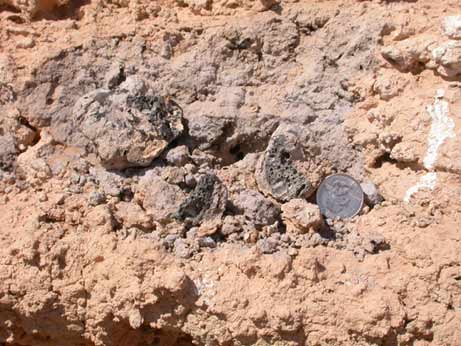
Fragments of so-called
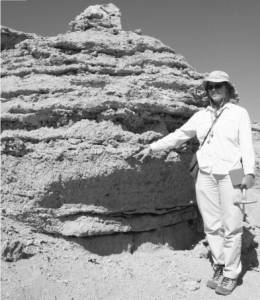
Dakhla Glass appear in clumps of ancient lake sediment.
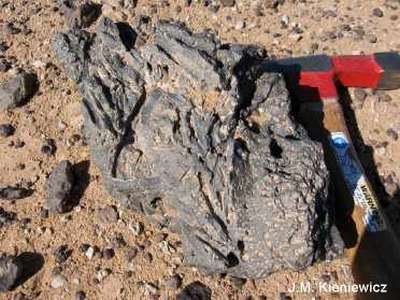
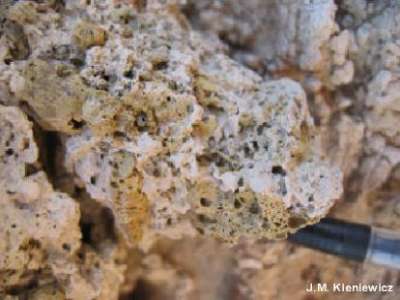
Photos by A. Haldemann / J.M. Kieniewicz
|
|
|
|
My belief is: The Dakhla "Glass"
is not caused by an airburst or impact event
The Dakhla "Glass" is a glassy
andesitic lava !
Apparently is the occurrence of "Dakhla Glass"
associated with Middle Pleistocene lacustrine sediments in situ. But this
can be a fallacy. It can be also moved material of older period, coming
from distantly regions. A determination of the age of the material of
~150 ka is mysterious. It is assumed that this indicates the age of the
sedimentary embedding and so the age of the Paleo-lake.
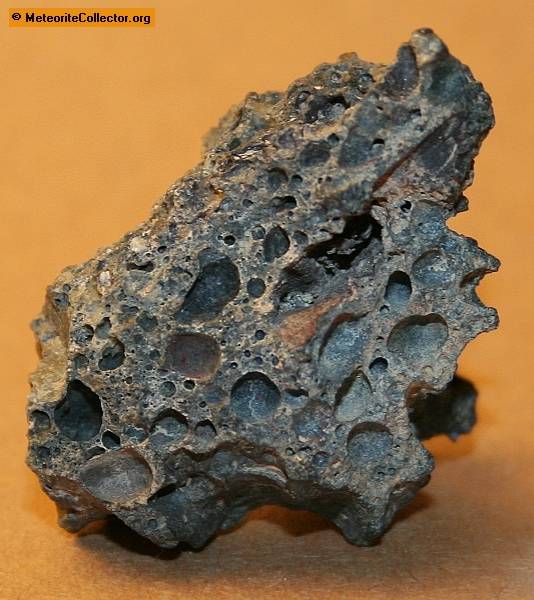
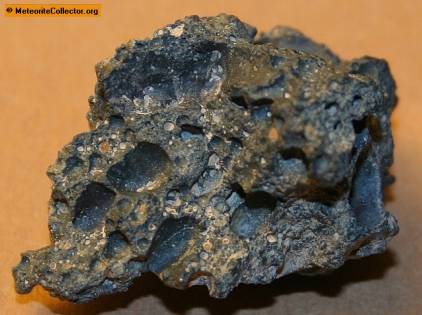
Dakhla glass is quite variable. Smaller pieces tend to be highly
vesiculated while bigger lumps can be mostly crystalline and dense. The
glass is chemically distinctive, being unusually rich in calcium and aluminum.
It contains small enclaves of very high silica glass (lechatelierite)
which forms at temperatures greater than 1700 degrees C. Interestingly,
about one third of the pieces show imprints of plant matter on their surface,
indicating that the original melt were still of sufficiently low viscosity.
There is also sometimes seen a flow-stretching to the vesicles and a tendency
for them to be present in greater abundance near the upper surface of
a given specimen, again indicating fluid behavior that allowed the bubbles
to stretch and rise. The plant residues must be from the Tertiary period.
The striation on the surface point to a Phragmites (reed), which existed
since the Tertiary period..
The plant residues are attached with the glassy mass and was transported
together.
The Dakhla Glass (DG) was probably a volcanic glassy mass, mixed
with gases.
The new investigations (Osinski et al, 2008) confirm
for me, that the DG's are redeposited, therefore it is not in situ. The
glasses have probable a Tertiary age. The volcanic origin of the glassy
mass in the context with the spread subvolcanic activities in the southwestern
region is probable. Hydrovolcanic events are to be found everywhere in
the region, also in the White and Black Desert in the north (look
here).
The Dakhla Glass (DG) is emerged at the same time like the Libyan
Desert Glass. It consists mainly of gas-rich volcanic outflow mass, which
are mixed with sediment. The Libyan Desert Glass (LDG) is probably orthomagmatic-hydrovolcanic
of origin and have an age of ~28 Ma (Oligocene). Both glasses differ however
by the chemistry and origin substantially (look
here).
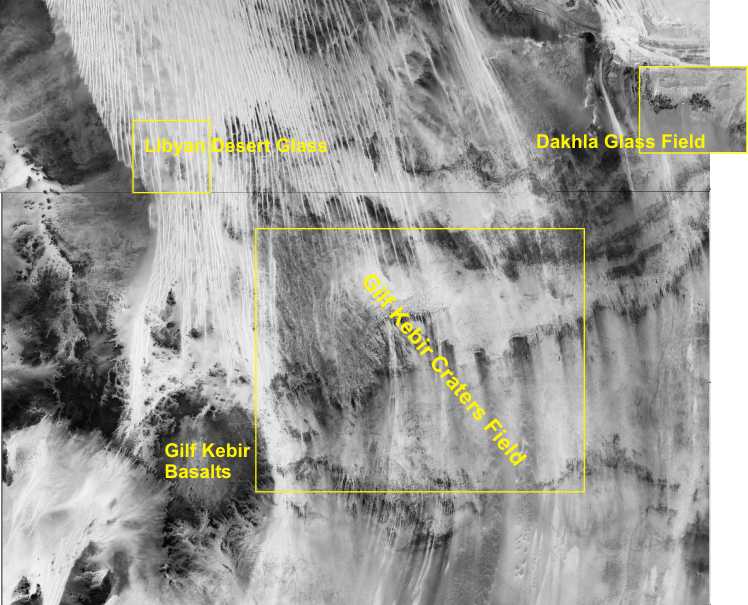
Between the Dakhla region and the Gilf Kebir plateau in the southwestern
direction exists an immense amount of examples for subvolcanic activities
in the Tertiary period (look
here). This region is rich of craters, basaltic plugs and dykes, which
contain fused sandstones and breccias as well as fractured quartz grains.
The place of the source is to be found in this large crater field of the
"Scarp-Contours" in the southwestern direction. The Dakhla Glass (lava)
after transport and destruction was deposited in a new position. Now it
is found allochthonous near Dakhla in younger paleo-lake sediments as
lumps.
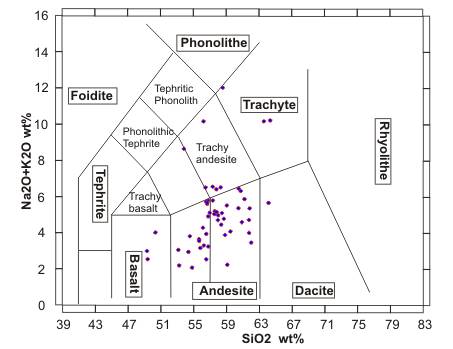
By
Osinski et al. (2008) published chemical analyzes clearly documents an
andesitic (dioritic)
composition of the DG
|
|
07-09 |
07-34 |
07-44 |
07-14 |
07-15 |
07-39 |
|
Oxide (wt%) |
range (7) |
average |
range (5) |
average |
range (3) |
average |
range (4) |
average |
range (2) |
average |
range (2) |
average |
|
SiO2 |
56.62 |
64.12 |
58.88 |
58.34 |
61.80 |
59.25 |
53.11 |
56.76 |
54.97 |
57.33 |
60.83 |
59.35 |
60.86 |
63.55 |
|
58.53 |
60.44 |
|
|
Al2O3 |
8.83 |
11.16 |
10.29 |
13.31 |
15.24 |
14.36 |
23.21 |
26.38 |
24.53 |
11.31 |
14.91 |
12.82 |
13.20 |
10.76 |
15.72 |
14.95 |
|
TiO2 |
0.43 |
0.76 |
0.68 |
0.83 |
0.93 |
0.88 |
0.80 |
1.45 |
1.03 |
0.73 |
0.88 |
0.77 |
0.70 |
0.82 |
1.08 |
0.88 |
|
MnO |
0.07 |
0.17 |
0.13 |
0.06 |
0.12 |
0.09 |
0.04 |
0.07 |
0.05 |
0.09 |
0.12 |
0.11 |
0.07 |
0.10 |
0.07 |
0.08 |
|
FeO |
2.52 |
4.69 |
3,78 |
3.83 |
6.01 |
4.89 |
2.44 |
5.12 |
3.62 |
3.34 |
5.67 |
4.82 |
5.73 |
6.47 |
4.32 |
3.39 |
|
MgO |
1.50 |
4.50 |
2.76 |
0.57 |
1.31 |
0.93 |
0.97 |
2.34 |
1.43 |
2.22 |
3.64 |
2.96 |
2.83 |
0.41 |
0.62 |
0.66 |
|
CaO |
10.54 |
17.85 |
15.68 |
12.20 |
13.48 |
12.87 |
7.13 |
11.26 |
9.78 |
7.79 |
18.03 |
12.24 |
10.34 |
6.68 |
7.12 |
12.76 |
|
Na2O |
2.12 |
2.41 |
2.25 |
2.07 |
2.60 |
2.34 |
0.99 |
1.60 |
1.30 |
2.32 |
3.14 |
2.62 |
1.92 |
6.29 |
5.91 |
2.69 |
|
K2O |
2.76 |
3.54 |
3.12 |
2.39 |
2.92 |
2.70
|
1.57 |
2.57 |
1.92 |
2.40 |
3.84 |
2.85 |
2.67 |
3.85 |
6.09 |
2.68 |
|
|
|
D8-LG2 |
D11-DGB |
D8-GGS |
|
Oxide (wt%) |
range (2) |
average |
range (3) |
average |
range (2) |
average |
|
SiO2 |
57.75 |
60.47 |
|
53.80 |
64.31 |
58.10 |
49.30 |
49.38 |
|
|
Al2O3 |
12.24 |
13.63 |
12.73 |
17.30 |
14.81 |
17.03 |
16.52 |
|
TiO2 |
0.85 |
0.86 |
0.70 |
0.92 |
0.84 |
1.25 |
1.33 |
|
MnO |
0.12 |
0.05 |
0.10 |
0.27 |
0.17 |
0.15 |
0.14 |
|
FeO |
4.31 |
3.83 |
2.59 |
6.88 |
4.49 |
7.54 |
7.17 |
|
MgO |
3.79 |
2.93 |
0.62 |
0.83 |
0.46 |
4.77 |
4.27 |
|
CaO |
12.76 |
10.66 |
6.80 |
11.59 |
9.27 |
15.88 |
17.25 |
|
Na2O |
4.42 |
4.31 |
4.72 |
6.17 |
5.24 |
2.43 |
1.94 |
|
K2O |
1.98 |
2.13 |
3.82 |
5.48 |
4.43
|
0.48 |
0.62 |
|
|
Kellis basin (in situ) |
Kellis basin (on Taref sandst.) |
|
Oxide (wt%) |
02-29 |
07-013 |
07-040 |
DG-8 |
D11-DGC |
average |
07-020 |
07-042 |
average |
|
SiO2 |
56.74 |
61.73 |
56.63 |
62.00 |
57.30 |
58.88 |
56.11 |
56.50 |
|
|
Al2O3 |
8.37 |
12.46 |
12.07 |
10.60 |
11.00 |
10.90 |
10.31 |
11.52 |
|
TiO2 |
0.56 |
0.86 |
0.74 |
0.82 |
0.71 |
0.74 |
0.67 |
0.73 |
|
MnO |
0.07 |
0.12 |
0.09 |
0.10 |
0.09 |
0.09 |
0.07 |
0.08 |
|
FeO |
3.75 |
6.16 |
5.00 |
5.38 |
4.30 |
4.92 |
3.53 |
4.46 |
|
MgO |
4.62 |
3.25 |
3.49 |
4.04 |
4.79 |
4.04 |
7.19 |
4.38 |
|
CaO |
12.36 |
8.91 |
11.99 |
10.47 |
12.29 |
11.20 |
16.81 |
12.65 |
|
Na2O |
3.64 |
2.64 |
3.42 |
2.30 |
4.40 |
3.28 |
2.50 |
2.46 |
|
K2O |
2.15 |
1.37 |
2.26 |
1.17 |
2.15 |
1.82
|
1.79 |
3.09 |
|
|
|
|
Kellis basin (on eroded CSS) |
Teneida Basin (on eroded CSS) |
Balat Basin (on eroded CSS) |
|
Oxide (wt%) |
07-025 |
02-34b |
02-34b |
07-037 |
07-034 |
Average |
07-044 |
07-007 |
07-053 |
00-28b |
92bes6b |
00-18b |
00-18c |
07-051 |
Average |
00-27b |
07-024 |
07-054 |
|
SiO2 |
54.52 |
58.28 |
56.43 |
55.65 |
56.52 |
56.28 |
55.80 |
59.08 |
57.94 |
50.31 |
53.22 |
56.51 |
54.79 |
56.23 |
55.49 |
59.47 |
56.76 |
58.81 |
|
Al2O3 |
11.60 |
9.99 |
9.64 |
11.74 |
11.18 |
10.83 |
20.65 |
10.04 |
8.86 |
7.35 |
8.76 |
7.77 |
7.49 |
7.25 |
9.77 |
10.36 |
9.10 |
9.00 |
|
TiO2 |
0.87 |
0.65 |
0.63 |
0.79 |
0.75 |
0.74 |
0.96 |
0.68 |
0.62 |
0.51 |
0.50 |
0.53 |
0.52 |
0.44 |
0.60 |
0.75 |
0.66 |
0.62 |
|
MnO |
0.09 |
0.09 |
0.09 |
0.09 |
0.08 |
0.09 |
0.05 |
0.08 |
0.12 |
0.09 |
0.16 |
0.08 |
0.08 |
0.12 |
0.10 |
0.12 |
0.10 |
0.15 |
|
FeO |
5.01 |
4.06 |
4.03 |
5.18 |
4.77 |
4.61 |
7.79 |
4.06 |
3.45 |
3.19 |
4.25 |
3.25 |
3.21 |
2.95 |
4.02 |
3.97 |
3.83 |
3.55 |
|
MgO |
5.47 |
5.33 |
5.83 |
3.21 |
5.86 |
5.14 |
2.33 |
4.48 |
5.20 |
5.56 |
5.29 |
6.92 |
6.37 |
4.98 |
5.15 |
4.91 |
5.51 |
5.58 |
|
CaO |
12.74 |
12.05 |
12.85 |
12.75 |
15.23 |
14.02 |
8.06 |
17.69 |
15.24 |
18.74 |
20.97 |
19.43 |
20.14 |
16.95 |
17.15 |
14.89 |
15.27 |
16.23 |
|
Na2O |
2.18 |
3.95 |
4.04 |
2.21 |
1.61 |
2.80 |
1.19 |
0.85 |
1,41 |
1.83 |
0.82 |
0.84 |
0.57 |
1.17 |
1.09 |
2.48 |
3.11 |
1.13 |
|
K2O |
1.64 |
2.56 |
2.47 |
1.45 |
2.34 |
2.09 |
1.99 |
1,41 |
3.30 |
2.20 |
1.39 |
1.71 |
1.52 |
2.14 |
1.96 |
1.60 |
1.81 |
2.76 |
|
The results of the analysis are therefore surprising,
because obviously no exists a direct relationship to the basaltic effusions
in the region of Gilf Kebir and elsewhere in Egypt. Therefore we can assume
a special origin, similar to the origin of the LDG. In both cases, a reference
to an impact or airburst event is absurd. Already the attempt fails, to
find target sediments for such compositions. It is sure igneous material,
what came along of deep faults in this volcanic active region in the Oligocene
period, in which also hundreds of subvolcanic structures emerged.
|
Results of Investigation
THE DAKHLEH GLASS: Product of an impact airburst
or cratering event in the Western Desert of Egypt ?
Gordon R. OSINSKI -- Departments of Earth Sciences/Physics
and Astronomy, University of Western Ontario, Canada,
Johanna KIENIEWICZ -- Department of Geosciences, Denison University, Granville,
USA
Jennifer R. SMITH -- Earth and Planetary Sciences, Washington University,
Saint Louis, USA
Mark B. E. BOSLOUGH -- Sandia National Laboratories, Albuquerque, USA
Mark ECCLESTON -- Archaeology Program, La Trobe University, Australia
Henry P. SCHWARCZ -- School of Geography and Earth Sciences, McMaster
University, Hamilton, Canada
Maxine R. KLEINDIENST -- Department of Anthropology, University of Toronto
at Mississauga, Canada
Albert F. C. HALDEMANN -- European Space Agency, ESTEC HME-ME, Noordwijk
ZH, Netherlands
Charles S. CHURCHER -- Department of Zoology, University of Toronto, Canada
Source: Meteoritics & Planetary Science 43, Nr 12, 2089–2107
(2008)"Dakhleh Glass was first observed during
regional archaeological and palaeoenvironmental surveys in the 1980s and
1990s (Kleindienst et al. 2006), with 6 known occurrences (Osinski et
al. 2007). In 2007, we carried out a systematic search and discovered
DG at ~140 different locations throughout the Dakhleh Oasis.
Based on this new work, it is clear that DG occurs in 4 main settings:
(1) as a lag deposit on the deflated surfaces of Pleistocene lacustrine
CSS; (2) in situ within the same sediments as lag deposits on Taref Formation
sandstone surfaces in close proximity to the Pleistocene lacustrine sediments,
but in areas where these sediments have been completely removed, and (4)
redeposited on, or into, Holocene pan sediments. Searches of both older
Quaternary formations and younger alluvial terraces yielded no DG fragments.
Thus, an important observation is that the DG glass appears to be spatially
associated with Middle Pleistocene lacustrine sediments. Recent fieldwork
shows that these sediments were deposited in a lake (s).
|
|
DG is typically black when
fresh and greenish-grey when weathered. Our new field observations indicate
that individual specimens of DG vary markedly in terms of vesicularity,
which is often a reflection of the size of the individual specimens.
Smaller samples are typically highly vesicular, whereas larger masses,
up to several kg and 30-40 cm across, are partially to fully crystalline.
The majority of the large masses are flattened. Several of these flattened
masses possess irregular but moulded lower surfaces and flat, vesicular
upper surfaces, with an increase in vesiculation upwards. Many of the
larger pieces are whole masses and not fragments broken from larger blocks
consistent with lack of significant movement/erosion following deposition.
As noted previously, an unusual characteristic of the DG is that approximately
one-third of DG specimens studied display impressions or “pyromorphs”
of reed-like stems or leaves on the underside, or more rarely on other
surfaces or internally, of the large flattened masses.
DG has been found in situ within Pleistocene CSS of lacustrine origin.
It is notable that sediments associated with the in situ DG, although
chemically similar to the underlying lacustrine sediments, are reddened
and occasionally contain charcoal and silicified organic matter, which
are suggestive of burning. This is also consistent with the discovery
of maghemite in association with the in situ glass, which has been documented
in goethite-rich soils that experienced burning. These “burned” sediments
often occur in discontinuous lenses in the stratigraphy immediately above
the DG in the western, Kellis Basin, and have also been documented in
the eastern Teneida Basin, suggesting that fires across the Dakhleh Oasis
region may have been a significant feature of the aftermath of the glass-forming
event, implying the existence of moderately dense vegetation. Dewatering
structures consistent with rapid deposition of sediment, as well as those
that exhibit evidence for reworking, suggest that sediments may have been
transported and redeposited from elsewhere in the basin.
The Dakhleh Glass comprises a highly vesicular, glassy groundmass containing
primary crystallites (clinopyroxene, with minor plagioclase), spherules,
and lithic and mineral clasts:
Glass
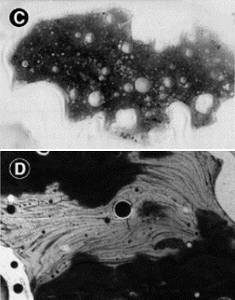
Optical and scanning electron microscopy observations mirror the field
and hand specimen observations and show that the DG bodies vary markedly
in terms of vesicularity. Despite its name, the Dakhleh Glass is typically
rich in crystallites. Hypohyaline (i.e., >80% glass) samples are rare
and hypocrystalline samples (i.e., mixtures of glass and crystals) predominate
so that actual glass contents range from ~35 to 10 vol%.
Completely crystalline samples are also present but are rare.
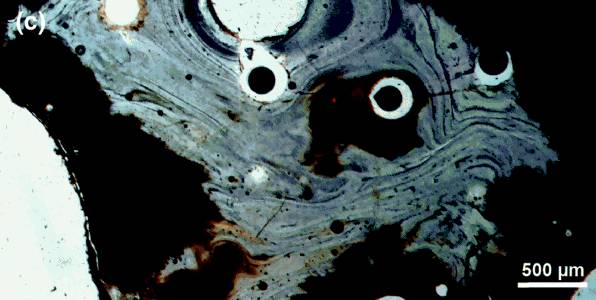
In thin section, crystallite-free glassy areas within DG glass samples
are colorless and transparent. The bulk of the DG samples, however, have
a grainy and “spotty” appearance.
This dark coloration can be explained by the interaction of incident light
with the crystallites, resulting in reduced light transmission through
the sample. The majority of DG specimens investigated display evidence
for flow in the form of elongated and irregularly-shaped vesicles and
intermingling of glasses of different composition.
X-Ray Fluorescence data for 24 individual samples of DG are presented
in Table 1. Given the bulk nature of these analyses (i.e., it was not
possible to completely separate clasts, spherules, globules, and secondary
alteration products from the glass), the data should be interpreted with
caution; however, these analyses are useful for assessing the major geochemical
properties of the DG. It is notable that the DG is typically CaO- and
Al2O3-rich, although there are considerable variations (e.g., from 8 to
21 wt% CaO) between individual samples and between different locations.
There is no systematic difference in composition between DG found as a
lag and that found in situ. Alkalis are typically <2 wt%. Loss-on-ignition
(LOI) data suggest the presence of variable amounts of volatiles. Some
of these volatiles are undoubtedly bound in secondary phases such as calcite
caliche and anhydrite; however, the systematically low WDS totals (typically
97–100 wt% in several samples suggest that the relatively high volatile
contents may be original. The lack of perlitic fractures also suggests
that these volatile contents may be original. This is consistent with
the pristine condition of the DG and the current hyper arid environment.
Primary Crystallites
Clinopyroxene has previously been identified as the most common crystalline
component of DG. This mineral displays a variety of crystal shapes, with
skeletal morphologies predominating. Such morphologies are indicative
of rapid crystallization from a melt due to high degrees of undercooling
and supersaturation.
Larger mm-size acicular and tabular crystals show some zonation, with
Mg-rich cores. In addition, these large crystals can contain spherical
and irregularly-shaped globules of FeS. The pyroxenes display varied compositions.
In the current study, we have also documented the presence of plagioclase
crystallites in the DG for the first time. This identification is based
mainly using element maps as the small size of the crystallites precluded
an accurate determination of their composition.
Spherules
In the DG, small spherules of pyrrhotite and larger sized spherules and
irregularly shaped globules of calcite are present. Pyrrhotite globules
also occur within large clinopyroxene crystals. It is notable that the
contact between the calcite globules and silicate glasses is always sharp,
but often can be irregular with intermingling of the calcite and glass.
The calcite globule morphology contrasts with the secondary calcareous
and sulfate vesicle fills, which are common in the uter few mm of many
of the glasses. We have also identified individual spherules of DG in
the Pleistocene lacustrine sediments.
Lithic and Mineral Clasts
Clasts of lithic and mineral debris are found in all samples, but typically
comprise <5 vol% of individual DG samples. The most common clast type,
found in all DG samples, are rounded to sub-rounded quartz grains. The
amount of clastic material can range from <1 vol% to ~10 vol%. There is
no systematic variation with respect to geographic location in the Dakhleh
Oasis, or between in situ and lagged samples. The quartz grains typically
display irregular fractures. No planar features have been found to date.
An unusual clast type can be seen. These elongate clasts comprise chains
of circular holes, resemble cross sections of grass, sedge or reed leaves,
and may represent recrystallized silica from phytoliths that retains some
of its botanical structural organization; phytoliths are microscopic amorphous
silicon dioxide particles that occur in various grasses (Piperno 2006).
This is consistent with the presence of reed stem, root, and leaf casts
in the CSS (Kieniewicz 2007).
WDS analyses and element maps (not presented) confirm that these clasts
are almost pure SiO2. Small angular fragments of fine-grained calcareous
sedimentary rocks of unknown origin have been found in 3 samples." |
|
|
|
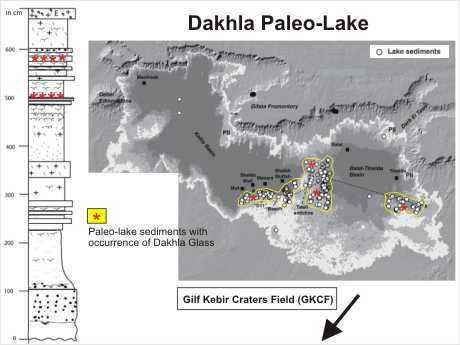
Source: Kieniewicz &
Smith, GSA-Bulletin (2009)
(map completed by me)
|
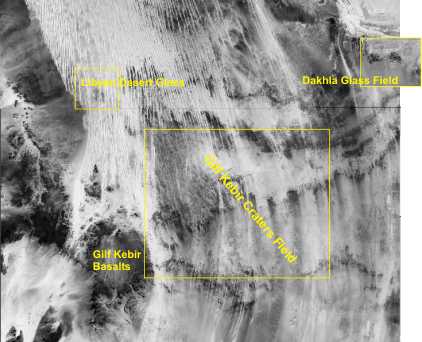
Subvolcanic activities in the
Gilf Kebir and Dakhla region
|
|
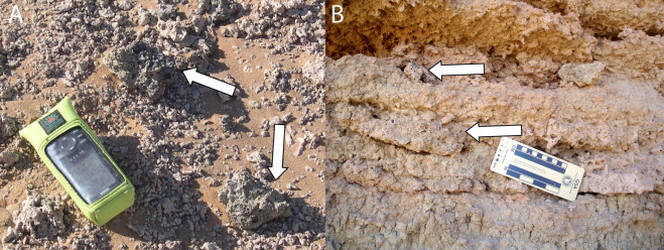
DG on surface and in lacrustine
deposits. Source: J.R. Smith et al, 2008
|
 |
|
|
|
|
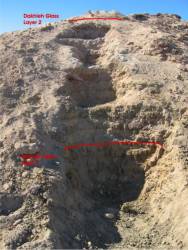
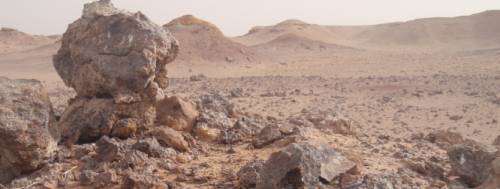
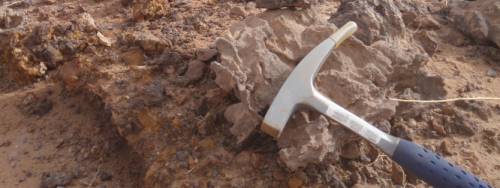
The sediments at
the bottom of the paleo-lake documented a short-term enormous kinetic
energy by flowing water. Source: Panoramio
|
|
|