

Athena
|
|
Athena |
Lockheed
Martin * ATK Thiokol Propulsion * Pratt & Whitney
Athena was developed commercially by Lockheed Martin to address the market for delivering
small spacecraft to LEO. The Athena family includes two small launch vehicles, the
three-stage Athena I (syn.
LMLV-1) and the four-stage Athena II. Both vehicles are made up of solid motors
and a small liquid injection stage, called the Orbit Adjust Module (OAM). The vehicles
are modular, and the Athena II
shares all the components of Athena I with the addition of an extra Castor-120 solid
motor. The Athena I preceding version is the LLV-1,
developed by Lockheed based on a Peacekeeper first-stage.
The Castor-120 is a commercial SRM developed by Thiokol. It is a derivative of the
Peacekeeper ICBM first stage motor TU-903. It has the same diameter as the
PK, but is 35 in. longer to include more propellant. The casing is filament-wound
graphite-epoxy composite, and TVC is provided by a new blowdown hydraulic nozzle
gimbal system.
The Pratt & Whitney's Orbus-21D motor is derived from the Orbus-21 motors used in
the IUS and TOS upper stage for the Titan. For the future missions Lockheed Martin
will upgrade to the Orbus-21G motor, which has a lightweight graphite-epoxy motor
casing in place of the current Kevlar case.
The OAM is a small, monopropellant hydrazine stage that provides precise orbit injection.
Axial propulsion is provided by four small 220 N thrusters around the circumference
of the stage. The OAM is available with four or six propellant tanks. The
tanks are mounted in pairs in an egg-crate frame structure inside the stage.
The standard fairing is the Model 92 (diameter 92 in.) with a 7.6 ft. length.
|
Performance |
LEO | LPEO | SSO | GTO |
|
Athena I |
0.80 | 0.52 | 0.36 | - |
|
Athena II |
2.00 | 1.49 | 1.16 | 0.59 |
Lockheed Martin and Alliant Techsystems (ATK)
will attempt to resurrect the long-dormant Athena series of small-satellite launchers
under an arrangement.
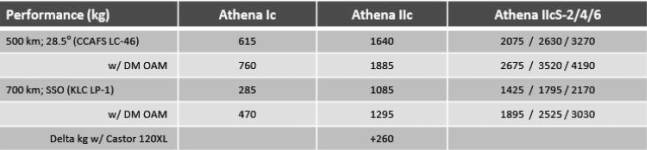
The upgraded Athena Ic
and Athena IIc
rockets will feature the same Castor-120 solid rocket motors as their predecessors,
but use the newly developed Castor-30 motor for their upper stage. The original
Athena vehicles used the Orbus-21D motor built by the former Chemical Systems Division
of United Technologies Corp. The new Athena vehicles will starting in 2012 (not
realized up to now).
Lockheed Martin and Alliant Techsystems (ATK) now plans to build a further
Athena IIcS with 2, 4 or 6 strap-ons Orion 50SXLG. It will be
launched from Kodiak.
Castor-120XL
This variant of the Castor-120 predecessor is used as a first or second stage in
commercial launch vehicles and provides improved performance over the baseline configuration.
A version of this motor was static tested for the U.S. Air Force as part of the
Large Class Stage development program, however the motor is being updated to tailor
burn rates and improve performance, as well as utilize common materials & processes
to improve cost control for launch vehicle providers.
In addition to Athena family, Castor 120XL is also in preparation for Minotaur-C
(ex-Taurus family) and Minotaur-I Commercial version which are in the process of
being merged into one sub-family under Minotaur-I.