



Soyuz STARSEM
|
|
Soyuz STARSEM |
STARSEM *
TsSKB Progress * ROSKOSMOS
| Orbital launches | Period |
Last launch |
|||
|
Soyuz-U |
Ikar |
11A511U |
6 |
1999 |
|
|
Soyuz-U |
Fregat |
11A511U |
4 |
2000 |
|
|
Soyuz-FG |
Fregat |
|
9 |
2003 - 2008 |
|
|
Soyuz-2 (2.1a) |
Fregat |
|
6 |
2006 - 2013 |
|
|
Soyuz-2K (2.1b) |
Fregat |
|
1 |
2006 |
|
|
Soyuz-2K (2.1b) |
Fregat |
|
12 |
2020 - 2022 |
|
Ziel des
im Juli 1996 gegründeten franko-russischen Konsortiums "STARSEM" (Space Technology
Alliance based on R-7 Semyorka Launch Vehicles) ist die internationale Vermarktung
der russischen Trägerrakete Soyuz mit den Varianten Soyuz-U und Molnya-M einschließlich
ihrer geplanten Weiterentwicklungen. Beteiligt sind Aerospatial, Arianespace, der
Hersteller TsSKB Progress und die russische Raumfahrtbehörde.
Erster Kunde ist "Globalstar". Eigens für dessen Satellitensystem wurde die Version
Soyuz-U/Ikar entwickelt. Es handelt sich um eine vierstufige Variante der Soyuz-U.
Die neue vierte Stufe "Ikar" befindet sich zusammen mit der Nutzlast innerhalb des
Fairing. Die Stufe ist wiederzündbar und wurde aus der Antriebssektion des russischen
Aufklärungssatelliten Kometa (Yantar 1KFT) abgeleitet. Die Ikar hat ein Haupttriebwerk
(2,943 kN) und 16 Steuertriebwerke (max. 0,695 kN) und kann bei 0,820 t Treibstoff
eine theoretische Brenndauer von 600 sec erreichen. Der Fairing wurde von dem militärischen
Soyuz-Yantar Programm übernommen.
Der erste Start einer Soyuz-Ikar datiert vom 09.02.1999. Bisher wurden 6 Globalstar-Starts
von Tyuratam in Kasakstan durchgeführt. Der erste Start einer Soyuz-U/Fregat erfolgte
am 08.02.2000.
Die erste Weiterentwicklung der Soyuz-U wird die Soyuz-FG/Fregat sein. Geplant ist
eine Schuberhöhung der ersten beiden Stufen durch Einbau modifizierter Triebwerke
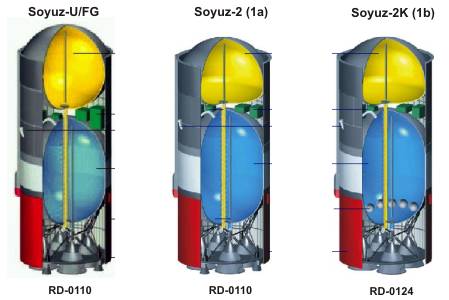
(RD-107A/RD-108A). Bei der folgenden Soyuz-2/Fregat) wird die dritte
Stufe Block I dann schrittweise verbessert. Zunächst werden die Tankgrößen einem
veränderten Mischungsverhältnis der Treibstoffkomponenten angepaßt
(Soyuz-2.1a). In der zweiten Phase wird das Triebwerk
RD-0110 durch ein RD-0124 ersetzt (Soyuz-2.1b). Als
zusätzliche vierte Stufe kommt eine verbesserte "Fregat" zum Einsatz.
Die Fregat wird aus der Antriebseinheit der Mars- und Venussonden der U.S.S.R. abgeleitet.
Das Einkammer-Triebwerk von Lavozkhin (entwickelt aus einem KTDU-425) erreicht bei
einem Massendurchsatz von 6,1 kg einen maximalen Vakuumschub von 19,6 kN. Bei einer
Brenndauer von 877 sec werden 17,2 MN*s Total-Impuls erzielt.
Die Fregat muß aufgrund ihres Durchmessers von 3,48 m in eine erweiterte Nutzlastbucht
integriert werden. Es soll ein neuer STARSEM-Fairing mit max. 11,4 m Länge
und 4,11 m Durchmesser entwickelt werden, der dem Ariane 4 Fairing ähnelt.
Zunächst wurde die Fregat jedoch auf einer unveränderten Soyuz-U eingesetzt. Dazu
wurde ein modifizierter Fairing der Proton-K mit einem Durchmesser von 3,70 m und
einer Länge von 7,70 und 8,30 m aufgesetzt.
Der erste Einsatz der weiter verbesserten Soyuz-FG/Fregat erfolgte am 02.06.2003
mit Mars Express.
Now an enlarged new payload fairing
for Starsem's upgraded Soyuz-2.1a launch vehicle is now ready for integration with
its MetOp-A satellite passenger, which will be launched from Baikonur Cosmodrome
in Kazakhstan.
This new fairing enables a full range of satellite payloads to be accommodated,
increasing the workhorse Soyuz launch vehicle's capabilities on commercial missions.
The derived Ariane fairing has a length of 11.4 meters and an external diameter
of 4.1 meters.