
Chang Zheng CZ-5
|
|
Chang Zheng CZ-5 |
China National Space Administration * China Academy of Launch Vehicle Technology (CALT) * China Aerospace Science and Technology Corporation (CASC)
A new CZ-5 NGLV series is being planned using modular stages. Boosters of various capabilities would be assembled from three modular stages of 2.25 m, 3.35 m and 5.0 m diameter. The new generation launch vehicle will be based on the 120 t thrust LOX/Kerosene core engines known as YF-100, and the 50 t thrust LOX/LH2 engine known as YF-77. The development of these engines began in 2000 and 2001 respectively, and they were successfully tested in 2005. Compared to the UDMH/N2O4 engine used by the current Chang Zheng family, the new generation engines have much lower poisoning gas emission as well as better reliability.
|
2.25 m diameter module powered by one 120 tons thrust Kerosene/LOX engine YF-100 |
K2-1 |
|
2.25 m diameter module powered by one new 18 tons thrust Kerosene/LOX engine YF-115 |
K2-2 |
|
3.35 m diameter module powered by two 120 tons thrust Kerosene/LOX engines YF-100 |
K3-1 |
|
3.35 m diameter module powered by four 18 tons thrust Kerosene/LOX engines YF-115 |
K3-2 |
|
5.00 m diameter module powered by two 52 tons thrust LH2/LOX engines YF-77 |
H5-1 |
|
5.00 m diameter module powered by 20 tons thrust LH2/LOX engine YF-75D |
H5-2 |
The CZ-5-2.25
small launcher would use the 2.25 m diameter core and a upper stage of the
same diameter. Payload is estimated as around 1.8 tons to low earth orbit or 1.3
tons to a sun-synchronous polar orbit.
The CZ-5-3.35 medium launcher
would use the 3.35 m diameter core with four 2.25 m diameter core stages as strap-ons
(or not) and a upper stage. Payload is calculated as much as 12 tons to low earth
orbit or 5 to 7 tons to geosynchronous transfer orbit. Two upper stages are powered
by two Kerosene/LOX engines as well as the cryogenic upper stage from the CZ-3A.
The CZ-5-5.0 heavy launcher
would use the 5.0 m core stage together with a number of modular 2.25 m or 3.35
m diameter stages as strap-ons. Lower payloads could be achieved by using
2 x 2.25 m plus 2 x 3.35 m strap-on stages; 4 x 2.25 m strap-on stages, or two of
either stage. For GTO missions a cryogenic upper stage with engine YF-75D is added.
Maximum payload with four 3.35 m diameter strap-ons is given as 23 tons to low earth
orbit or 11 tons to geosynchronous transfer orbit.
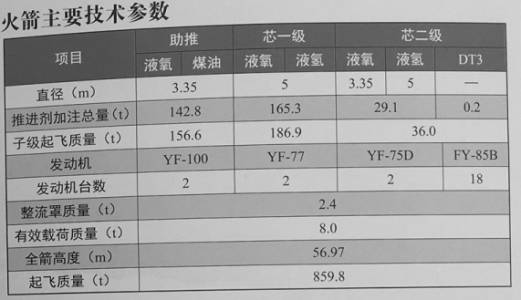
CZ-5 # 3 specification