|
Remarks to the origin of Shatter-Cone
like structures
in the Gilf Kebir region (Egypt)
Norbert Brügge,
Germany
Dipl.-Geol.
In the year 2004 explored
Philippe Paillou and a team by two fieldworks (February and December) a large
number of circular structures in the east of the Gilf Kebir. The fieldwork
should confirm that is a new "impact" crater field. The impact origin was
derived by the observation of shock-related structures, such as Shatter-Cones
and planar deformatiuons in quartz grains. These craters (several hundred)
are however of subvolcanic origin and the shatter-cone like structures are
not valid. Related forms were found also outside of the crater field in the
Gilf Kebir region. Most of them were modelled by wind erosion and are Pseudo-Shatter-Cones
(PSC).
Shatter-cone like structures
are widespread worldwide, and not infrequently. Most of them are not valid
because they not meet the cone-in-cone criteria. Valid Shatter-cons were usually
found in or nearby structures that classified as impact-crater. However, this
is not certain because a volcanic origin of such structures must often be
assumed. However, this discovery is difficult to convey because "Shatter-cone"
is automatically and permanently linked to "Impact". I think that Shatter-cones
can arise not only by shock waves during an impact event. But, no of the existing
hypotheses for the formation of shatter-cones currently is able satisfactory
explain the characteristics of this fracturing phenomenon.
I refer in this context to the
mysterious angular sandstone columns in Jebel Uweinat (Egypt), and Israel,
Scotland, Germany, Australia and Paraguay, which were clearly created by volcanic
shock waves.
|
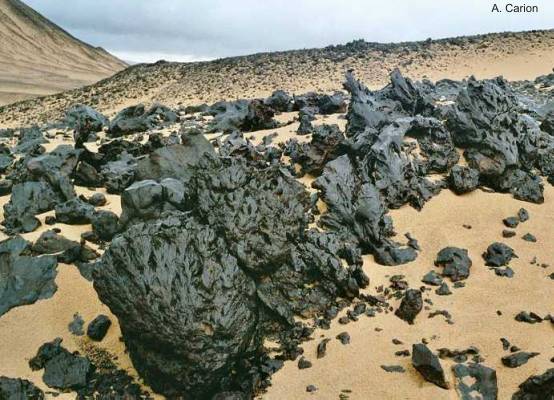
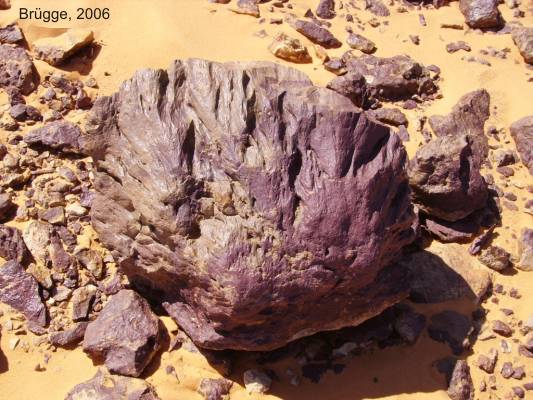
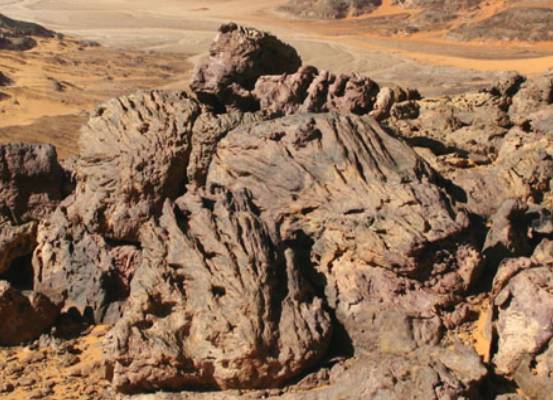
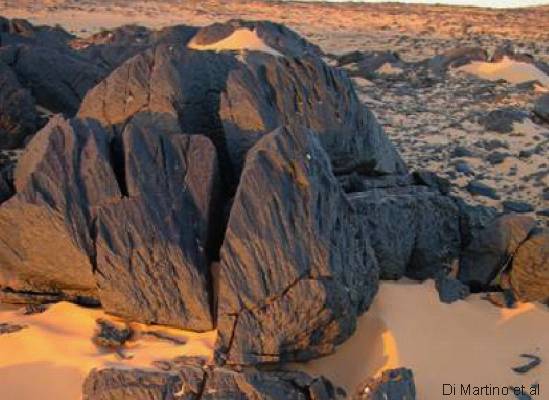
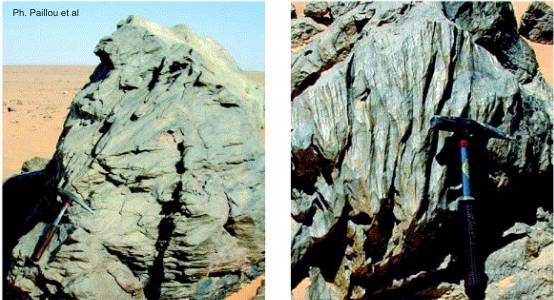
Samples of Shatter-Cone
like structures from the Gilf Kebir region (Egypt)
|
|
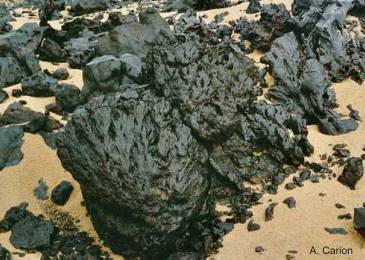
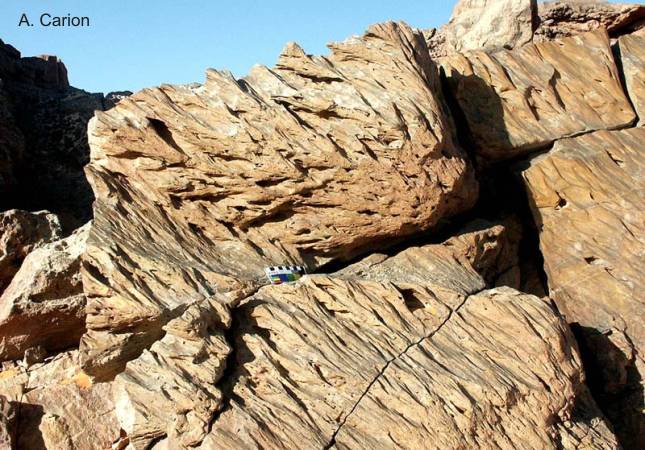
Pseudo-Shatter-Cones nearby oasis
Bahariya (Black Desert)
|
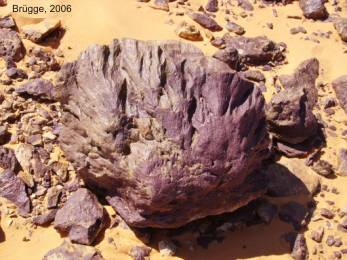
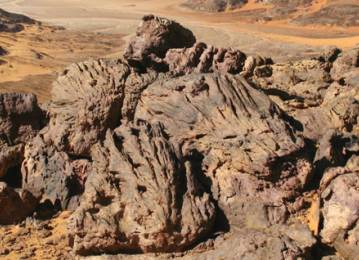
Top of Gilf Kebir plateau: Wind
scratches on sandstone
|
|
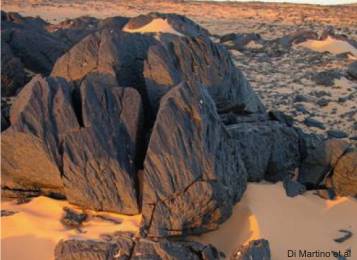
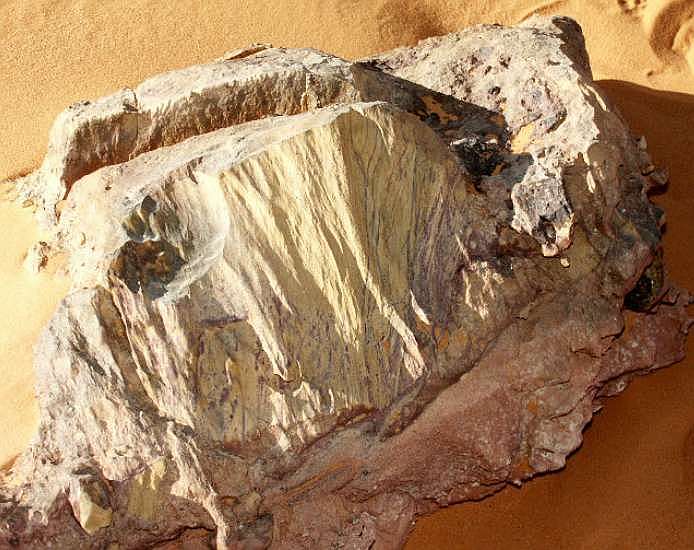
Shatter-Cone like structure at "El-Baz"
crater
|
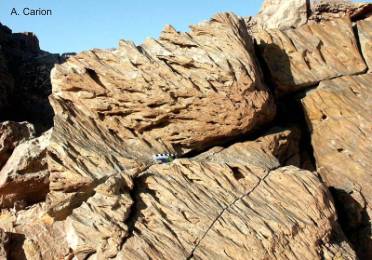
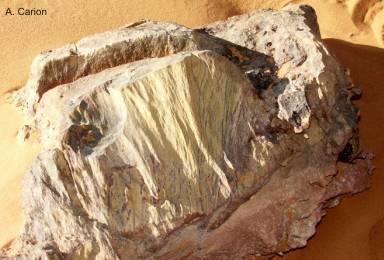
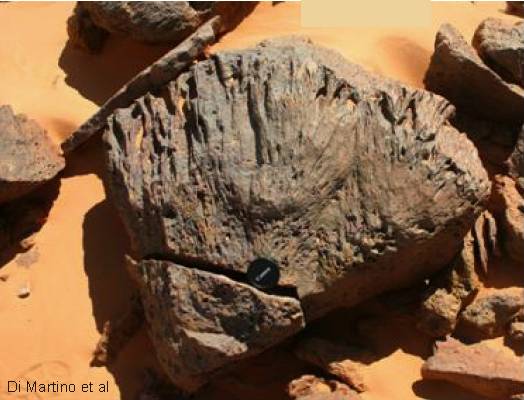
Shatter-Cone like structures at
GKCF-13 (Gilf Kebir Crater Field)
|
|
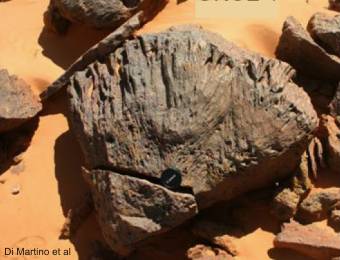
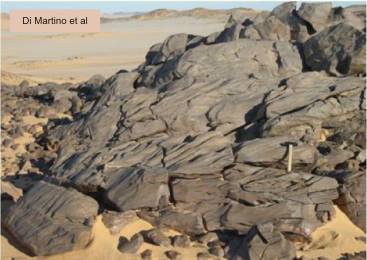
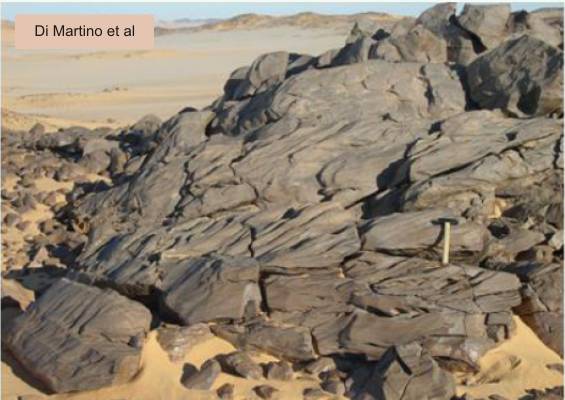
Pseudo-Shatter-Cones at GKCF-01
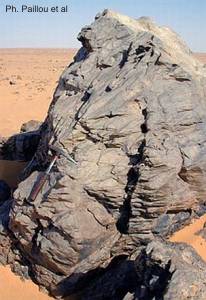 
Pseudo-Shatter-Cones at Arkenu crater
|
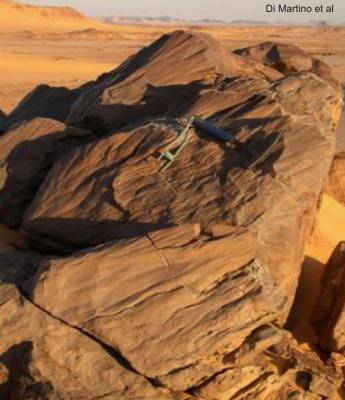
GKCF-01: 23°14,5' N & 27°27,5' E
|
|
DIAGNOSTIC CRITERIA
FOR THE RECOGNITION OF SHATTER CONES
H. M. Gibson and
J. G. Spray, Department of Geology, University of New Brunswick, Canada.
Shatter cones are commonly described as being conical striated fracture
surfaces formed due to hypervelocity impact. Other structures having
similar, but not identical morphological elements include blast fractures
and natural percussion marks, slickensides, wind abrasion structures and
cone-in-cone structures. Precise identification of shatter cones is necessary
to prevent confusion with these similar structures. A criteria for the
identification of shatter cones is based on elements of their morphology
combined with field habit. Three basic criteria must met for structure
to be considered a valid shatter cone:
- The structure must
be a conical, or part conical, fracture surface
- ridge and groove striations
diverging from an apex or central striae must be present
- and the structure
must be pervasive and not surficial.
Blast fractures are true
fracture surfaces, but do not display a conical fracture surface. Most
commonly they consist of a radiating array of planar fractures. Percussion
marks result from the impact of boulders in a rapid flow, fluvial
setting. They comprise a conical fracture surface that may include crude
striations, so their morphology is super-ficially similar to that of a
shatter cone. However, their occurrence is restricted to the outcrop surface
and, as such, they do not form a pervasive fracture System throughout
the rock. Slickensides have ridge and groove striations similar to those
of a shatter cone. However, the fracture surface is planar, or occasionally
curviplanar, and lacks the conical shape and divergent striations of shatter
cones. Cone-in-cone structures are not fracture surfaces, but are displacive
growths of calcite within a carbonate-rich sediment. As such they possess
a characteristic internal structure that is distinct from that found in
shatter cones. Conical structures formed as a result of wind abrasion
lack fracture surface and are spatially restricted to outcrop surfaces
and prevailing wind direction at the time of formation. if care is taken,
the above evidence can be used to distinguish true hatter cones formed
by hypervelocity impact from other conelike structures at the mesoscopic
scale (i.e., in the field). At the microscopic scale, shatter cones may
be further distinguished by the localization of planar deformation features
PDFs) in the vicinity of the cone surfaces, as well as by the presence
of spherules (vapor condensates) and high pressure polymorphs indicative
of shock.
|
A CRITICAL GUIDE FOR
IMPACT-CRATER HUNTERS
A publication of the Impact Field Studies Group (IFSG), vol.2. Winter 2005
Bevan M. French, Smithonian Institution
Shatter cones are the only known megascopic (outcrop and hand-specimen scale)
feature accepted as evidence of impact. Ideally, they occur as distinctive
multiple sets of curved and striated fractures that form cones or partial
cones and penetrate large volumes of target rocks in impact structures.
Shatter cones, even when poorly developed, tend to be directional: the cones
generally (but not always) point upward and inward (toward the shock-wave
source at the impact point), and the striations radiate backward from
the apex of the cone, diverging and multiplying along the cone surface to
form a unique texture ("horsetailing").
Well-developed shatter cones are distinctive, impressive, and unique indicators
of impact. Less well-developed shatter cones may form nearly-planar
striated surfaces which may lack directionality and which may be ambiguous.
Caution! Shatter cones, both good and bad, can resemble other geological features:
sedimentary cone-in-cone structures, fault slickensides, and wind-abrasion
features. However, shatter cones have distinctive features that help identification.
If you are standing on what you think is a shatter-coned outcrop, check the
following points. Shatter cones form in all rock types - igneous, sedimentary,
and metamorphic. The best shatter cones form in fine-grained rocks (limestones
and shales). Shatter cones in coarser-grained crystalline rocks are cruder
and harder to recognize. The orientation of shatter cones depends on their
location relative to the centre of the impact structure, and they will
therefore be oriented at any angle to sedimentary bedding. Shatter cones are
penetrative fractures; freshly-broken samples will show shatter-coned interior
surfaces. Shatter-cones have positive and negative surfaces; a convex cone
may nest snugly within a reversely-striated concave surface. Both positive
and negative shatter-cone surfaces will show grooves with positive and negative
relief. If you have surfaces that aren't curved, show only a few striations,
and have no radiating pattern, then play it safe; don't use such features
as an impact indicator.
Shatter cones have been recognized and argued as impact criteria for
more than half a century, but their mechanism of formation, and the conditions
under which they form, are still not well-established. They apparently form
at relatively low shock pressures (=>2GPa), but may also develop at pressures
=>30 GPa. Shatter cones formed at higher pressures (=>10 GPa) in quartz-bearing
rocks may also contain distinctive microscopic shock features such as PDFs
in quartz.
|